
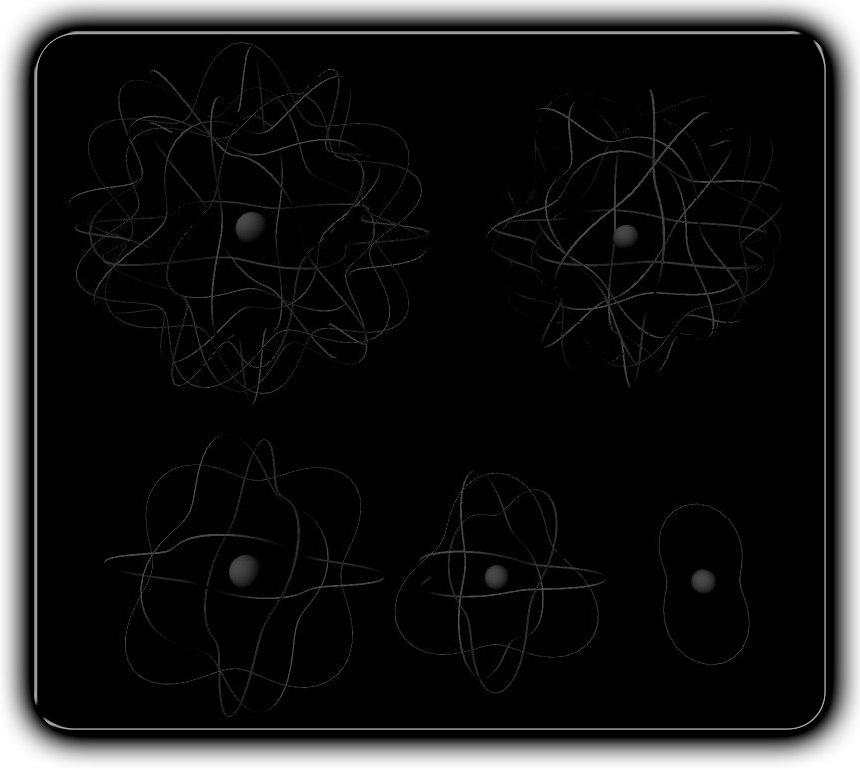
The central question
Can a particle-associated geometric field be formulated precisely enough to reproduce known behaviour and generate a distinct, testable prediction? My starting intuition is that particles might be associated with local spacetime production or expansion, with observable effects emerging from the structure and overlap of those fields.
Approach developed so far
Earlier working drafts explore a phase-bearing field, geometric gradients, and possible short-range corrections alongside electromagnetism. White-hole-like language has been used as an analogy for outward behaviour, not as evidence that particles are astrophysical white holes.
A representation explored in the drafts. Writing a familiar phase relation does not independently derive quantum mechanics.
Work completed
Conceptual manuscripts, equation sets, and comparisons with quantum-potential and geometric approaches have been drafted. Investigations also include electron length scales, nuclear-scale overlap ideas, and the fine-structure constant. Apparent numerical scale relationships remain exploratory until a physical mechanism and predictive calculation are established.
The next useful milestone
Specify the field, its dynamics, assumptions, and physical observables. Then test a constrained model against a benchmark before extending it. One proposed nuclear benchmark is reproducing deuteron binding without incorrectly predicting bound diproton or dineutron states.
Collaboration sought
Critical mathematical review, numerical modelling, and comparison with existing geometric and quantum-foundations literature. The objective is to identify what survives calculation and what needs to change.